


Osteoporosis changes the strength and internal structure of your bones, which means your exercise plan must be adapted with clinical precision. At The Physio Studio, pilates for osteoporosis is delivered through physiotherapist-led assessment, controlled movement, and safe bone-loading principles designed to support posture, balance, and long-term independence.
You may already know that pilates can improve control, flexibility, and strength, but osteoporosis requires a more careful approach than a standard fitness class. Your spine, hips, wrists, and ribs may need modified loading strategies that protect vulnerable areas while still encouraging useful skeletal adaptation.
The goal is not to avoid movement. The goal is to move in a way that stimulates bone remodelling, improves muscular support, and reduces your risk of falls without placing unsafe compression or twisting forces through fragile vertebrae.
How Our Specialised Physiotherapy and Pilates for Osteoporosis Programme Protects Your Bones
Low bone density needs more than general strengthening. Unguided gym classes or generic mat routines can be physically unsafe if they include deep forward bending, loaded spinal flexion, rapid rotation, or poorly controlled balance work.
At The Physio Studio, your programme is planned around your medical history, movement capacity, pain levels, postural control, and any bone density results available from your GP or consultant. This allows your physiotherapist to choose safe, progressive exercises rather than applying a one-size-fits-all routine.
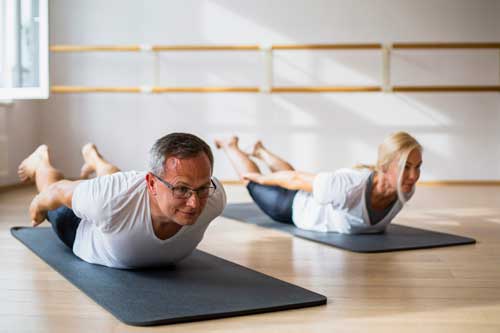
Safe Pilates for Osteoporosis Guided by a Chartered Physiotherapist
Osteoporosis silently reduces bone mineral density and weakens the microarchitecture inside your bones. This makes areas such as your hip, wrist, and spine more vulnerable to fracture, especially when movement is fast, poorly controlled, or loaded in the wrong direction.
Managing this structural risk falls within the scope of musculoskeletal physiotherapy, where exercise is prescribed according to your tissue tolerance and clinical condition. For pilates for osteoporosis, this means using targeted, site-specific loading rather than high-impact, forceful movements that your bones may not tolerate.
Your physiotherapist may use modified weight-bearing positions, resistance bands, supported standing work, and carefully progressed bodyweight tasks. These methods are based on progressive resistance training principles, where the load is increased gradually enough to stimulate bone and muscle adaptation without overwhelming your spine or joints.
A fragile spine can also contribute to postural collapse, stiffness, and recurring discomfort through your back and rib cage. When this happens, targeted physio for back pain may be integrated into your plan to improve spinal support, reduce excessive strain, and help you move with better control during daily tasks.
Protecting Your Spine from Strain During Pilates for Osteoporosis Sessions with a Physiotherapist
The osteoporotic spine needs clear safety boundaries. Deep forward folds, aggressive abdominal curls, rapid twisting, and loaded flexion can place dangerous compressive forces through the front of the vertebrae, increasing the risk of wedge fractures.
At The Physio Studio, pilates for osteoporosis is adapted to reduce these risks. Your physiotherapist will prioritise axial extension, neutral spinal control, shoulder blade positioning, hip mobility, and smooth breathing patterns instead of asking you to force your body into unsafe ranges.
This does not mean your sessions are passive or overly gentle. You may work through standing balance drills, modified hip hinges, supported arm loading, controlled side-lying strength work, and band-resisted postural exercises that challenge your muscles while protecting your vertebrae.
Some of these principles overlap with our targeted pilates for scoliosis programme, especially when spinal alignment, rib cage position, and asymmetrical loading need close attention. Physio Scoliosis Specific Exercise frameworks can help guide how we observe spinal shape, postural compensation, breathing mechanics, and safe alignment during clinical mat-based exercises.
Finding the Right Clinical Exercise Group for You with Physiotherapy Support
Your starting point matters. Some people need highly controlled floor-based movements before progressing to standing work, while others may be ready for supervised balance training, band resistance, and more demanding postural endurance exercises.
Our structured small-group environments are available through specialised clinical classes at Pilates Dunshaughlin and Pilates Donnybrook. These settings allow your instructor to monitor your alignment continuously, adjust your resistance, and help you avoid positions that may increase spinal or joint strain.
Props may include resistance bands, small balls, cushions, wall support, and carefully selected mat positions. These are used to help you find safe skeletal alignment, reduce unnecessary gripping, and build strength through controlled ranges rather than forcing movement.
For significant bone density loss, joint sensitivity, or low confidence with exercise, beginners pilates approach may be the safest starting point. This allows you to practise transitions, breathing, postural awareness, and low-impact strengthening before progressing into more challenging work.
Improving Balance to Prevent Falls and Protect Your Joints with Physiotherapy
Bone preservation is only one part of osteoporosis care. Preventing falls is equally important because many fractures occur when reduced bone strength meets poor balance, slow reaction time, or weak lower-limb control.
At The Physio Studio, clinical movement tracks are used to train deep core stability and lower-limb proprioception together. You may practise controlled weight shifts, supported single-leg balance, step preparation, hip strengthening, ankle control, and slow transitions from sitting to standing.
Pilates for osteoporosis can be especially useful when balance, posture, and strength are trained in the same session. The aim is to help your body respond more effectively when you turn, step off a kerb, climb stairs, carry shopping, or recover from a small loss of balance.
Strong lower-body pillars need the same alignment principles used in knee physiotherapy, especially when your knees, hips, and ankles must track safely under load. Better joint control helps you build a reactive muscular support system around your spine, pelvis, and legs, giving you more stability during everyday movement.
Book Your Initial Clinical Physiotherapy Assessment Today
Safe and effective bone loading must be individualised. Before starting pilates for osteoporosis, you need a comprehensive physical examination with a qualified physiotherapist at The Physio Studio.
Your assessment may include posture analysis, spinal movement screening, balance checks, strength testing, gait observation, and a review of any relevant bone density metrics. Your physiotherapist will also identify movements that should be avoided, modified, or progressed carefully.
This initial appointment sets clear boundaries for your programme. It helps ensure your exercises are measurable, clinically appropriate, and matched to your current fracture risk, confidence, pain levels, and functional goals.
Contact a Chartered Physiotherapist at The Physio Studio
Speak with The Physio Studio to arrange your initial clinical appointment or to ask about class suitability, accessibility, and location options. A chartered physiotherapist can guide you towards the safest starting point and explain how your programme can be adapted around your bone health, posture, and movement needs.
To book an appointment or ask a question, email The Physio Studio at info@thephysiostudio.ie, call 01 825 0151, or 083 177 8885.
In the consult we will:
Identify
Assess your posture, balance, spinal control, bone health history, and movements that may need modification.Treatment
Use physiotherapist-led pilates to improve strength, balance, posture, and safer bone loading.Tailored Solution
Build a plan around your bone density, mobility, pain levels, confidence, fracture risk, and exercise goals.It will also include:
Examination
Review spinal movement, gait, balance, strength, posture, and tolerance for controlled loading.Assessment
Identify unsafe bending, twisting, weakness, poor balance, joint strain, and fall-risk factors.Results
Help improve posture, stability, strength, balance, and confidence during everyday movement.Contact us!
Call us on 01 8250151 to speak with one of our friendly team, ask any questions or to start getting help.
Alternatively, fill in a form, and we will get back to you as fast as possible.
You’ll be glad you did.
Client Testimonials
My experience of the clinic can be described as hugely positive. Excellent professional service by the team. The physiotherapy treatment and advice that I received was tremendously effective. Based on my experience I strongly recommend.Donal Carey
Great experience, had back pain and was seen by Ava weekly for nearly 2 monhts, she sorted out all the issues and was very happy with her. Great jobJames Cregan
Very positive experience, Had a back problem and it took a few weeks to sort but with the help of the team there is was sorted. Many thanks to Gerry and Ava for the helpMichael Higgins
Gerard obviously knows his stuff. Gave me very good advice.Stephen Horan
Accepted Insurances